Customers Are Like Fish

Get seen
in the water.Then get the yes.

A guided 3-stage audit that diagnoses your visibility, your shareability, and your discovery conversations — then tells you exactly what to fix first.

Takes about 15 minutes. Nothing is saved unless you download it.

No email requiredNothing saved to a databaseBased on Sharp, Berger, Rackham & Voss
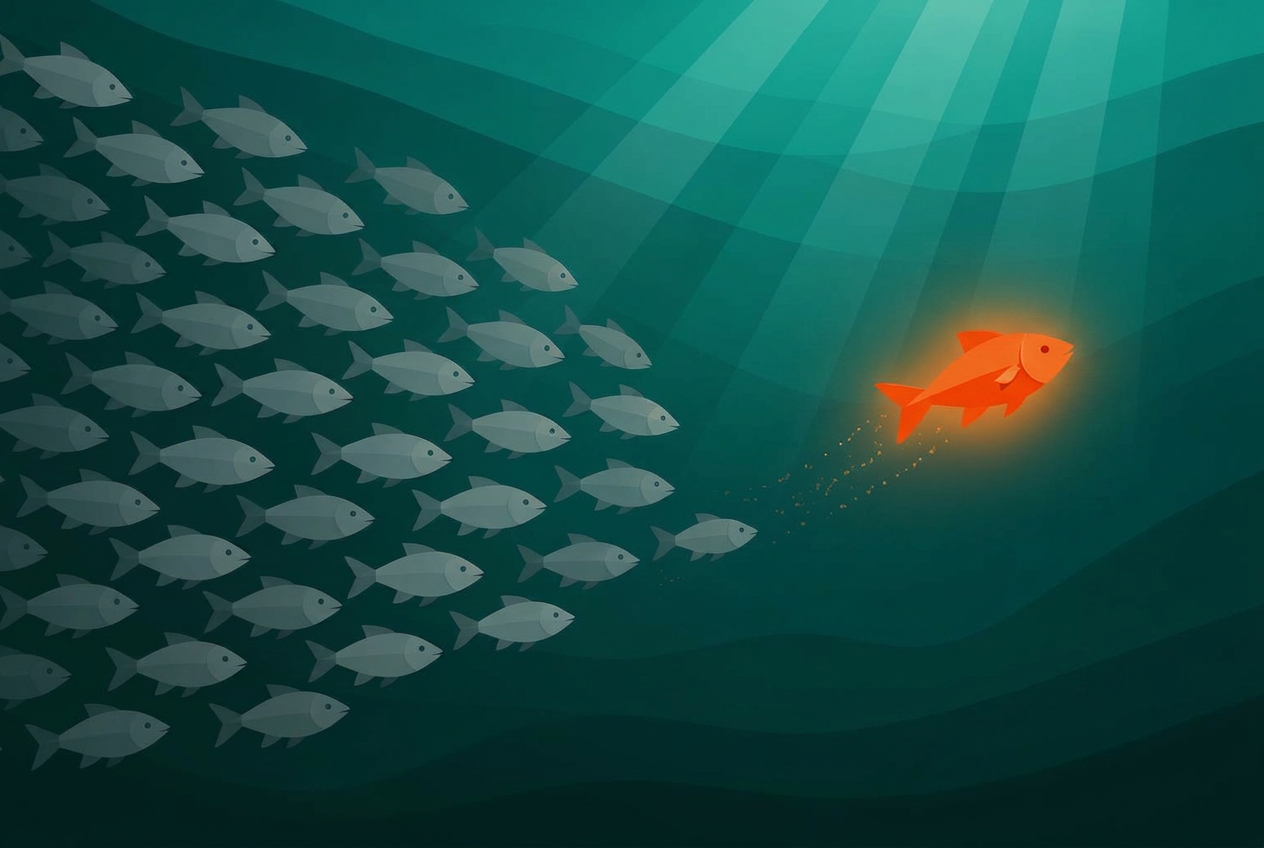
A school of muted grey-blue fish swimming together while one bright amber fish stands out in a shaft of light
What you walk away with

Three concrete artifacts, not advice.

Visibility & Conversion Guide
A 3-page document with your full diagnosis, shareability audit, and conversation redesign.
Four priority moves
Ranked by impact so you know exactly what to ship first, not what to do eventually.
Rewritten discovery opener
A SPIN-based opening you can use on your next call to move from pitch to genuine yes.
Try it in 60 seconds

Three questions. One honest read.

Not ready for the full 15 minutes? Answer three questions and get an instant sense of which layer is costing you the most business — no email, no signup.

60-second check1 / 3

When someone in your market realises they have the problem you solve, what usually happens?

The three-stage audit

Found. Repeated. Believed.

01
Visibility
Can they find you
02
Shareability
Is it worth talking about
03
Discovery Conversation
Are you pitching or listening
How the audit works

A structured method, not a magic chatbot.

The AI applies four proven frameworks to your answers. You get the depth of a strategy workshop in the time of a coffee break.

1
Answer guided questions
10–15 structured questions about where your business shows up, what clients say, and how you open discovery calls.
2
The frameworks do the work
Your answers are mapped to Sharp (availability), Berger (STEPPS), Rackham (SPIN), and Voss (Tactical Empathy).
3
Get your custom guide
In about 15 minutes you receive a concrete, prioritized guide with moves you can act on this week.
Start My Session

No signup. No data saved. About 15 minutes.

Illustrative scenarios

Better referrals start with being seen.

Four composite examples showing how the audit is used and what a result could look like. These are illustrations written for this page — not results reported by named clients. No outcome is promised.

ExampleStage 1 — VisibilityB2B SaaS analytics · 14 people

Referral introductions went from 3 a quarter to 11

3 referral intros / quarter11 referral intros / quarterover 2 quarters

The audit scored mental availability 2/5: buyers only searched after a failed data migration, but nothing they published used that phrase. They rewrote the homepage and founder bio around the trigger and shipped four posts using the same wording. Inbound stayed flat for six weeks, then referral intros nearly quadrupled because peers finally had language to pass along.

+267% referral introsSales cycle 61 → 48 days
ExampleStage 2 — ShareabilityIndependent brand consultancy · solo

Word-of-mouth went from 22% to 68% of new leads

22% of leads referral-led68% of leads referral-ledin 5 months

Practical Value was strong, Stories was absent — clients were happy but described the work as "branding help." They built one canonical story with a number, a villain and a timeframe, then asked five past clients whether it matched how they'd describe it. Two rewordings later, the story started coming back verbatim in intro emails.

3.1× referral-led leadsPaid ad spend cut to zero
ExampleStage 3 — DiscoveryExecutive coaching practice · 2 partners

Discovery-to-proposal conversion rose from 31% to 58%

31% of calls → proposal58% of calls → proposalacross 42 calls

They opened calls with credentials at minute two, so the prospect never priced the problem out loud. Swapping in the four-question SPIN sequence and one labelling line moved the cost conversation to minute twelve. Same lead volume, nearly double the proposals — and fewer calls that stalled after the pitch.

+27 pts conversionAverage fee up 18%
ExampleAll three stagesRegional logistics consultancy · 5 people

Cost per new client fell 41% while referrals doubled

$4,200 cost per new client$2,480 cost per new clientin 90 days

They shipped all four priority moves in one quarter: trigger language on the site, a one-paragraph client story, a rewritten discovery opener, and a branded scorecard left behind at every engagement. The scorecard alone produced two inbound requests from departments they had never met. This is the scenario used in the published sample guide.

−41% acquisition cost2.0× referral volume

These scenarios and their figures are illustrative composites created to show how the audit is applied. They are not testimonials, not verified client results, and not typical or expected outcomes. No specific result is promised — what you get depends on your own market, your offer, and what you actually ship.

Sample output

This is what the guide looks like.

Not a generic checklist. A concrete diagnosis built from your answers, with specific moves you can ship this week. The sample below is an illustrative example built for a fictional business.

Visibility & Conversion Guide
Executive Summary

Mental availability 2/5, physical 4/5. Findable once someone looks — invisible at the moment the need appears.

Stage 1 — Visibility Diagnosis

Owned: one search term, a directory listing, two partner referrers. Unowned: the buyer's actual trigger phrase.

Stage 2 — Shareability Audit

All six STEPPS drivers rated. Highest-leverage gap: Stories — clients get results they cannot repeat in one breath.

Stage 3 — Discovery Conversation

Credentials at minute two replaced with a four-question SPIN sequence and one Voss labelling line.

Four Priority Moves

1. Own the trigger sentence. 2. Write the canonical client story. 3. Replace the call opener. 4. Ship a branded leave-behind.

Flat illustration of a gold lure making ripples on the water

The bait matters more than the boat.

Find out where your market is looking, why they'd talk about you, and what to say when they finally show up.

Start My Session
No email requiredNothing saved to a databaseBased on Sharp, Berger, Rackham & Voss
Straight answers

Questions people ask first.

Isn't this just ChatGPT with extra steps?+

No. The session follows a fixed three-stage sequence and can't skip ahead, and each stage has to produce specific outputs — availability ratings, category entry points, six STEPPS drivers, a four-question SPIN sequence — before the guide is assembled. You get a structured diagnosis, not an open-ended chat.

Who sees my answers?+

Nobody. There is no account and no database. Your answers stay in this browser tab and are sent only to the AI model that generates your guide. Close the tab and they're gone unless you downloaded the guide.

What if the output is generic?+

The audit probes vague answers with follow-ups before moving on, so specificity in equals specificity out. The more concrete you are about where clients came from and what they actually said, the sharper the four priority moves will be.

How long does it take?+

About 15 minutes — roughly 10 to 15 short questions. You can answer in a sentence or two each.

Can I use this with my team?+

Yes. Download the guide as PDF or Markdown, or copy it as text and paste it into your docs. The one-line summary at the top is designed to be pasted straight into a team channel.

Want the detail? Read how the four frameworks are applied.

Start My Session